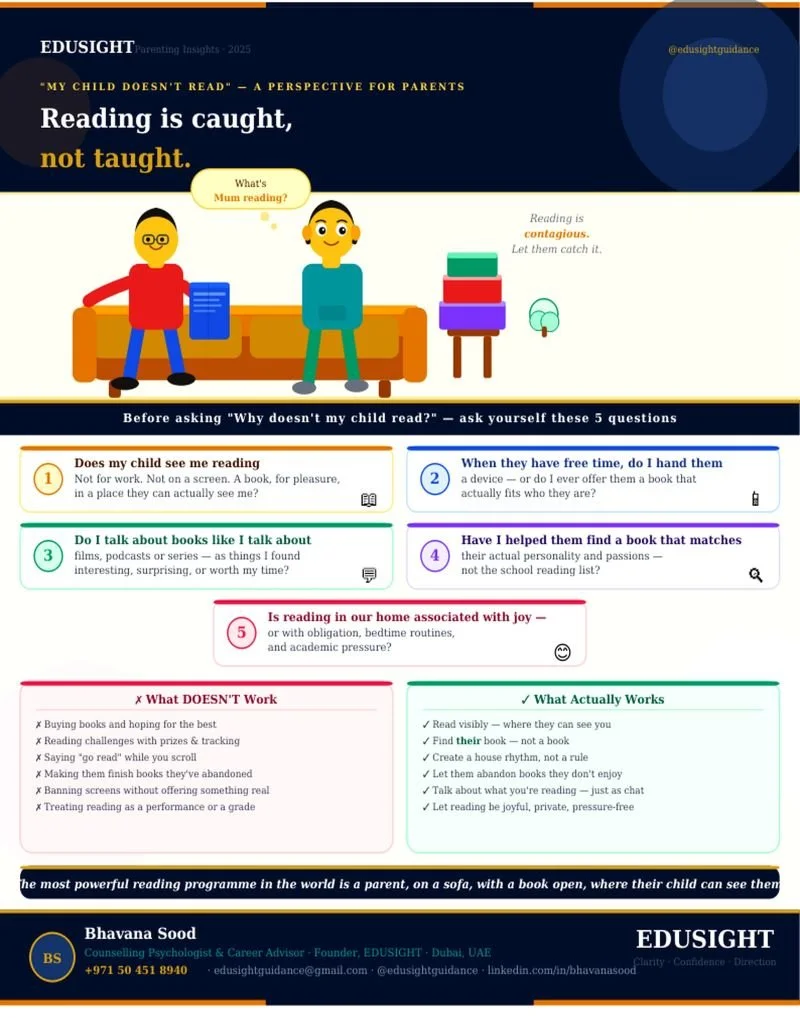
Reading is caught, not taught.
One of the most common things parents say to me:
"My child doesn't read. I don't know how to get them to pick up a book."
I always ask the same question back "Does your child see you reading?"
Not for work. Not on a screen. A book. For pleasure. In a place they can see you.
The answer is no.
And I understand completely. Life is full, evenings are short, phones are everywhere, and reading feels like one more chore.
You cannot grow a reading habit in a child from a home where no one reads.
Children do not follow instruction. They follow culture.
If the culture of your home is screens in the evening, that is the behaviour that becomes normal. Books remain what school asks for.
I've heard every variation of this:
"I bought him a whole shelf of books. I read to her when she was little."
"She did a reading challenge at school and loved it, but then stopped at home."
"I banned screens for a week. He was miserable. He still didn't read."
Here is where it went: it went when reading stopped being something they watched the adults around them do.
What parents can actually do — starting tonight:
Put your own phone down in front of them and pick up a book.
This one act is worth more than a hundred conversations about the importance of reading.
Find their book, not a book.
A child obsessed with sport, gaming, animals, fashion, real crime, space, food, coding — there is a book built for their exact brain. The reading list rarely has it. A good bookseller, librarian or counsellor can.
Create a house rhythm, not a rule.
Thirty minutes. No screens. Everyone in the family does something quiet. You read. They can read, draw, write, think. The habit isn't reading — it's slowness. Reading follows.
Never make them finish a book they hate.
The fastest way to kill a reading habit is forced completion. Let them stop. Let them choose. Permission to quit a book sends the message: books are for you.
Talk about what you're reading.
Not as a lesson. Just as conversation. "I read something strange today. A character did something I completely didn't expect." Curiosity is contagious.
20 minutes of daily pleasure reading improves performance across every subject — not just English. It builds focus, vocabulary, inference, empathy and the ability to sit with difficulty without reaching for a screen. These are not literacy skills. They are thinking skills. Life skills.
But no amount of school reading lists, challenges, or parental instruction will build this habit if a child has never seen a real person in their life choose a book freely, for themselves, because they wanted to.