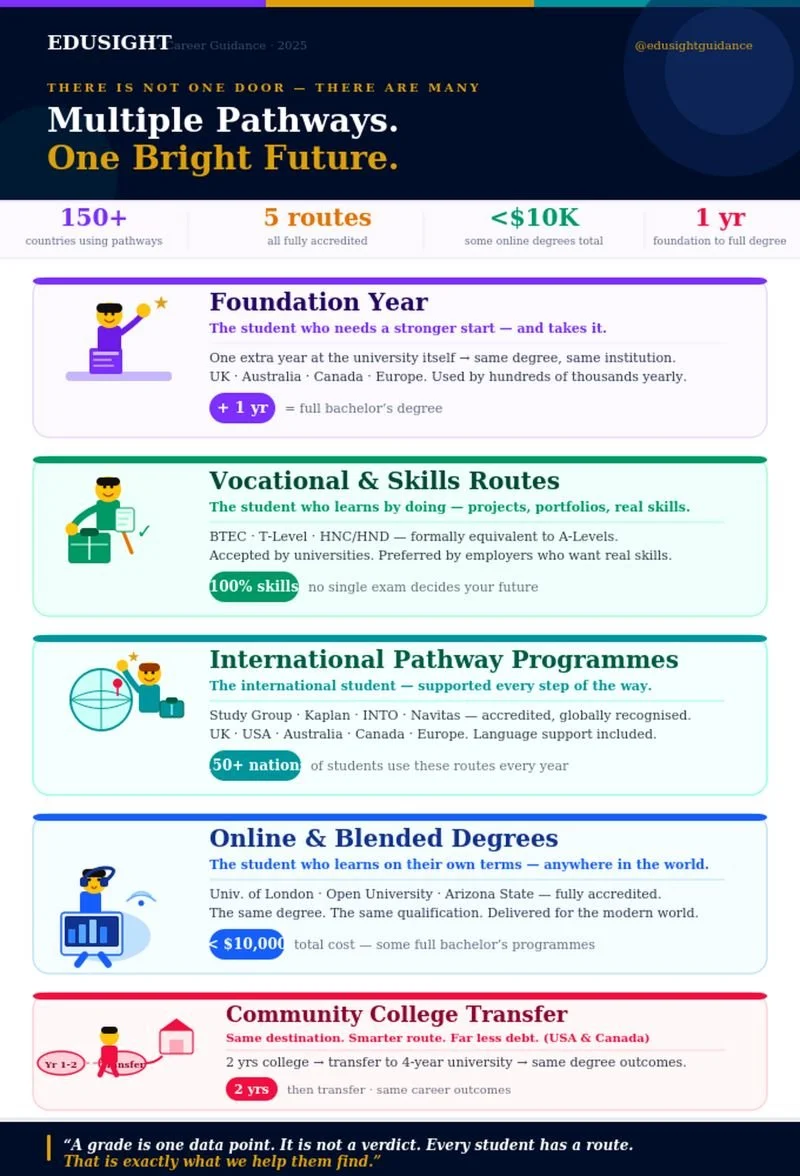
Multiple pathways. One bright future.
The student had just received his predicted grades. They weren't what anyone had hoped for.
There is a student out there right now — maybe in your home, maybe in your child's class — who looked at their grades last week and quietly decided that the door had closed.
A student's grades are one data point. They are not a verdict.
The landscape of higher education and career pathways looks nothing like it did even ten years ago. The students who are thriving are not always the ones who took the straight, narrow, high school route. They are the ones who found the right route for who they actually are.
Here is what actually exists right now — accredited, employer-recognised, and built around real-world skills:
FOUNDATION YEARS
A student who doesn't meet direct entry requirements doesn't lose the university. They gain a year — at the university itself — to prepare, grow and enter the bachelor's programme fully ready. Same institution. Same degree at the end. A different, and often better, starting point.
VOCATIONAL & SKILLS-BASED ROUTES
BTECs, T-Levels and HNC/HND qualifications are built around doing — projects, portfolios, real-world application. Formally equivalent to A-Levels. Accepted by universities. Increasingly preferred by employers who care far more about what a candidate can actually do than how they performed under pressure on a single exam day.
PATHWAY PROGRAMMES
These are structured, internationally accredited routes into universities in the UK, USA, Australia, Canada and Europe. Used by students from over 150 countries every year. Designed for students who need a little more time, language preparation or academic foundation before stepping into a degree.
ONLINE & BLENDED DEGREES
There are institutions now offer fully accredited bachelor's degrees delivered online or in flexible blended format. Built for a world that has already moved on from the idea that learning only counts if it happens in a lecture hall.
COMMUNITY COLLEGE TRANSFERS (USA & CANADA)
Two years at community college, then a seamless transfer to a four-year university often arriving at exactly the same destination a direct applicant would have reached, at a fraction of the cost and without the weight of significant student debt. Widely used. Strategically brilliant.
What connects every single one of these routes?
They are all real. They are all respected. The shape of a student's intelligence does not always fit the shape of a traditional exam. The student who struggles to perform in a three-hour paper but thrives on a live brief may be the most gifted designer, engineer or strategist in the room.
The student who earns while they learn may understand the real world better than any lecture could have taught them.