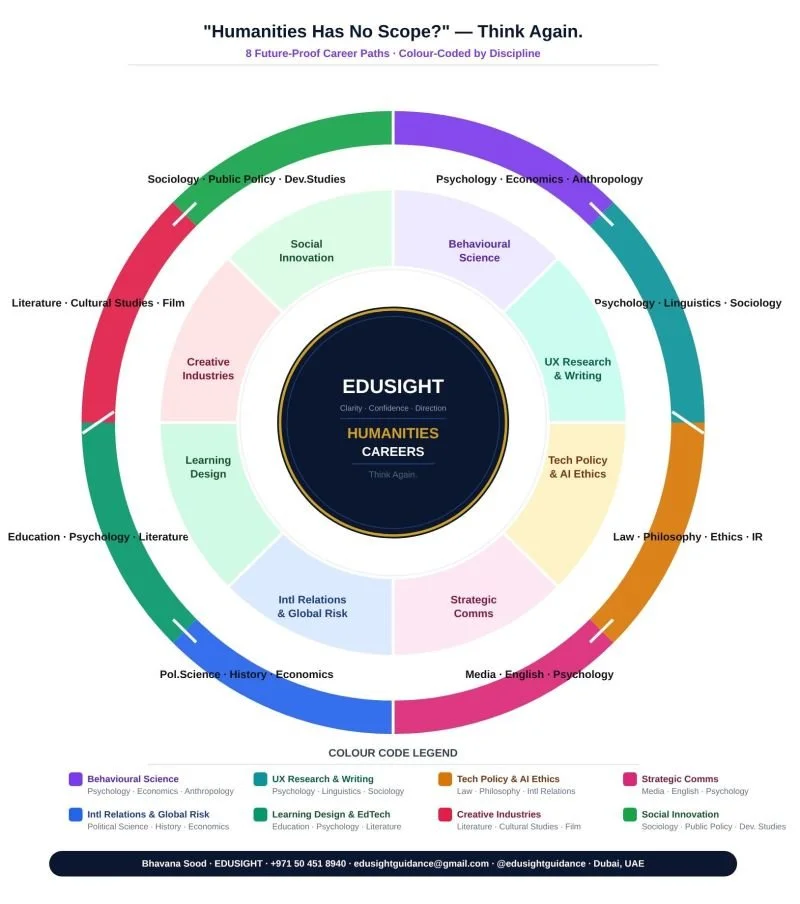
“Humanities has no scope?” Think again.
What if the “brave” choice isn’t STEM… but Humanities?
A student walks in and whispers,
“I actually like psychology / history / politics / literature…
but everyone says humanities has no future.”
They’re not lacking interest.
They lack permission.
Here’s what needs to be asked:
What problems in the world make you angry or curious?
Whose stories do you never get tired of listening to?
What topics do you naturally overthink, research, debate?
Very often, their answers point straight to humanities-powered careers:
A teen who loves analyzing characters and relationships → psychology, behavioral science, user research
A news‑obsessed student who tracks elections and global events → international relations, public policy, political risk
A creative writer who can’t stop making notes and scripts → UX writing, brand storytelling, content strategy
A young activist who cares deeply about fairness and rights → law, tech policy, AI ethics, development and social impact
What do these roles have in common?
They all sit at the intersection of humans + systems + technology.
The issue is not “scope”.
The issue is that most students have never seen the map of what humanities can lead to.
When we finally lay out that map in a session, we can see the shift on their faces from “I’ll disappoint everyone” → to “I have real, global options.”
Humanities subjects are becoming more important in a tech-driven world, not less. When students build strong foundations in psychology, economics, politics, sociology, history, languages and communication, they can step into some of the most future‑focused, globally relevant and high‑paying careers,
If you’re a parent, educator, or student reading this:
Humanities is not the “backup plan” anymore.
It’s a powerful path for those who want to work with people, ideas, systems, and change. With the right guidance, it can be just as high‑impact and high‑paying as any traditional STEM route.